
Africa sits at the center of a global agricultural revolution, possessing immense untapped potential to feed not only its own growing population but markets worldwide. The continent’s agricultural export supply chain represents a complex ecosystem that transforms raw produce into internationally traded commodities, yet this journey from farm gate to global consumer faces significant challenges and remarkable opportunities.maersk+2
Understanding the Agricultural Export Supply Chain Structure
The African agricultural export supply chain operates through six interconnected stages that determine the success or failure of products reaching international markets. Production begins with smallholder farmers who represent 80% of Africa’s food production, utilizing inputs like seeds, fertilizers, and equipment. Harvesting and transport involves collecting produce and moving it from rural farms to collection points, often over poor road networks that affect 80% of African rural areas.alphaseeds+4
Primary processing and storage represents a critical bottleneck where Africa loses 30-70% of agricultural produce annually due to inadequate facilities. Secondary processing adds value through cleaning, sorting, packaging, and transformation into export-ready products. Distribution, packaging, and handling prepares goods for international standards and shipment requirements. Finally, wholesale and retail markets connect African produce to global consumers through established trade relationships.afrigcc+4
Current Export Performance and Market Dynamics
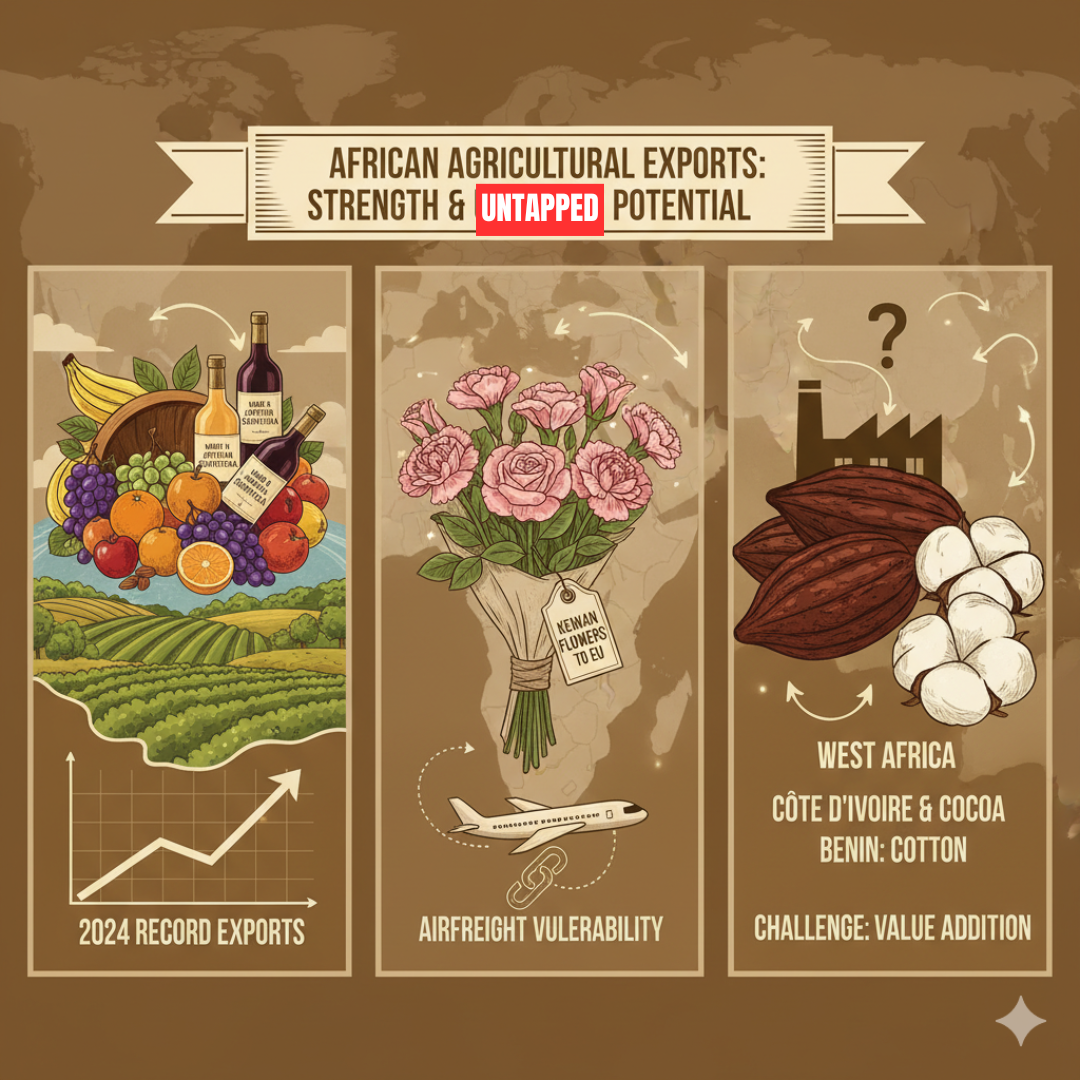
African agricultural exports demonstrate both strength and untapped potential across key markets. South Africa leads continental exports, dominating fruits and nuts (70.6% of African exports), sugar and confectionery, and beverages including wine and spirits. The country’s agricultural exports reached record levels in 2024, with 44% flowing to African markets, 21% to Asia and the Middle East, and 19% to the European Union.wandile.substack+2
Kenya’s horticultural sector exemplifies successful export specialization, with flowers generating KES 72.1 billion in 2024 and representing 40% of EU flower imports. However, the sector relies heavily on airfreight, which became a critical vulnerability during COVID-19 when passenger flight cancellations reduced cargo capacity and increased costs.iconcox+2
West African nations maintain strong positions in traditional exports, with Côte d’Ivoire and Ghana controlling significant shares of global cocoa trade, while countries like Benin dominate cotton exports. Yet these nations face persistent challenges in value addition, exporting primarily raw materials rather than processed goods.africanexponent+1
Infrastructure Challenges and Investment Needs
Africa’s agricultural export potential remains constrained by fundamental infrastructure deficits that increase costs and reduce competitiveness. Transportation networks present the most immediate barrier, with only 20% of sub-Saharan roads paved, forcing farmers to face up to 35 checkpoints and pay $134 in bribes for a single truck journey from Senegal to Mali.africanleadershipmagazine+1
Cold chain logistics represent both a major gap and growth opportunity. More than 40% of agricultural exports require cold chain treatment, yet adequate facilities serve only 15% of smallholder farmers due to high costs. Kenya has made significant progress, reducing spoilage rates for avocados by 40% through strategic cold storage investments and cutting port dwell times from 7 days to 48 hours for perishables.maersk+1
Irrigation infrastructure remains severely underdeveloped, with only 5-6% of African cropland irrigated compared to 21% globally. This creates vulnerability to climate variability and limits year-round production capacity essential for consistent export supply.african+2
Post-Harvest Losses: The Hidden Crisis
Post-harvest losses represent one of Africa’s most significant agricultural challenges, with different estimates revealing the scale of the problem. The FAO estimates losses of 37% between production and consumption, while the African Postharvest Losses Information System (APHLIS) provides more conservative estimates of 10-20% for cereals.brickstone+2
Eastern and Southern Africa alone lose $1.6 billion annually in grain value, representing 13.5% of total production value. The East African Community records particularly high losses: 30% in cereals, 50% in roots and tubers, and up to 70% in fruits and vegetables. These losses stem from inadequate storage facilities, poor transportation, and lack of proper packaging technologies.eac+2
Solutions are emerging through strategic investments. Improved storage technologies, pre-cooling facilities, and solar-powered cold rooms are demonstrating significant impact where implemented. However, scaling these solutions requires substantial capital investment and technical expertise.iconcox+1
Global Market Access and Trade Relationships
African agricultural exports face complex market access challenges that limit competitiveness in global markets. Tariff escalation within value chains remains a significant barrier, with processed agricultural products facing higher tariffs than raw materials in developed countries. Removing these barriers could increase Africa’s processed agricultural exports by 115%.policycenter
Quality standards and certification requirements create additional hurdles, with many African exporters facing rejection due to failure to meet international food safety and quality standards. The European Union, a key market representing 19% of South Africa’s agricultural exports, maintains strict sanitary and phytosanitary requirements that require traceability from farm to consumer.ahargroup+2
The African Continental Free Trade Area (AfCFTA) offers transformative potential for agricultural trade. The agreement projects a 574% increase in intra-African agricultural trade by 2030 if import tariffs are eliminated. This could reduce Africa’s $50 billion annual agricultural import bill while boosting domestic processing capacity.weforum+1
Technology and Digital Transformation
Digital innovation is revolutionizing African agricultural supply chains, offering solutions to longstanding challenges. Mobile technology platforms like Kenya’s M-Pesa enable secure farmer payments, while companies like Twiga Foods connect farmers directly to buyers, eliminating intermediaries and ensuring fairer prices.gafspfund+1
IoT and monitoring systems provide real-time tracking of agricultural shipments, preventing spoilage through temperature and humidity monitoring. Maersk’s remote container monitoring has shown significant promise in maintaining product quality during sea freight transport. Blockchain technology offers supply chain transparency, attracting investment and providing farmers with better market access.africanleadershipmagazine+1
Precision agriculture technologies, including drones and satellite monitoring, enable optimized fertilizer and water application, reducing costs while improving yields. However, adoption remains limited among smallholder farmers who lack access to capital and technical training.furtherafrica+2
Climate Resilience and Sustainability
Climate change presents both challenges and opportunities for African agricultural exports. Unpredictable weather patterns and increasing frequency of droughts disrupt production and supply chain reliability. However, climate-smart agriculture practices, including drought-resistant crop varieties and efficient irrigation systems, offer adaptation strategies.ahargroup+2
Sustainable farming practices are becoming market requirements rather than preferences, with international buyers increasingly demanding environmentally responsible production methods. This trend creates opportunities for African farmers who adopt sustainable practices but requires investment in certification and training.iconcox+1
Renewable energy integration in agricultural processing and storage offers cost reduction and environmental benefits. Solar-powered cold storage and irrigation systems are proving viable in rural areas with limited grid electricity access.african+1
Financial Constraints and Access to Capital
Limited access to finance remains a fundamental barrier to agricultural export development across Africa. Agricultural lending represents only 1% of commercial lending in many African countries despite the sector contributing 25-40% of GDP. Financial institutions perceive agriculture as high-risk due to weather dependence, long investment maturation periods, and lack of reliable collateral.insights.aib
Interest rates for agricultural loans often exceed double the economy-wide average, making capital expansion prohibitively expensive for most farmers and exporters. Export financing requires significant upfront investment in production, processing, packaging, and compliance with international standards.insights.aib+1
Innovative financing models are emerging, including government-backed loan schemes, rural credit programs, and partnerships with international development institutions. However, scaling these solutions requires coordinated policy support and risk-sharing mechanisms.african+1
Regional Integration and Trade Corridors
Regional cooperation offers significant opportunities for supply chain optimization and cost reduction. The Northern Corridor connecting Kenya’s Mombasa port to Uganda, Rwanda, Burundi, and the Democratic Republic of Congo exemplifies how regional integration can enhance trade efficiency. Similar corridors in other regions could unlock similar benefits.agroberichtenbuitenland
Cross-border harmonization of standards, regulations, and documentation could significantly reduce trade costs and delays. Currently, agricultural exports face multiple certification requirements and bureaucratic processes that increase costs and create uncertainty.ecdpm+1
Regional value chains enable countries to specialize in their comparative advantages while maintaining regional food security. Morocco’s solar irrigation systems, Nigeria’s cassava processing, and Kenya’s flower expertise illustrate potential for regional complementarity.afrigcc+1
Future Opportunities and Investment Potential
Africa’s agricultural export sector presents substantial investment opportunities across the supply chain. Agro-processing infrastructure requires an estimated $8 billion in storage investment alone, while fertilizer demand could increase 800% as production expands. Cold chain logistics represent a particularly attractive investment area given the 40% of exports requiring temperature control.maersk+1
Market projections indicate strong growth potential, with African agricultural production volumes expected to more than double by 2043. The continent could reduce its agricultural import bill by $212 billion while increasing export earnings by $227.6 billion through strategic investments in productivity and infrastructure.futures.issafrica
Public-private partnerships offer mechanisms for sharing investment risks while leveraging government policy support and private sector efficiency. Development finance institutions are increasingly backing infrastructure-led agricultural growth, creating opportunities for private investors.african+1
The transformation of Africa’s agricultural export supply chain from its current constrained state to its full potential requires coordinated investment in infrastructure, technology, and human capacity. Success stories from Kenya’s flower industry, South Africa’s fruit exports, and emerging digital platforms demonstrate that with proper support, African agriculture can compete effectively in global markets while providing sustainable livelihoods for millions of farmers. The key lies in addressing infrastructure bottlenecks, improving access to finance, and building regional cooperation that leverages Africa’s collective strengths in feeding the world.
- https://www.maersk.com/insights/digitalisation/2023/09/28/african-agricultural-exports
- https://www.iconcox.com/news/africas-cold-chain-logistics-boosting-agricultural.html
- https://afrigcc.com/2025/01/19/from-farm-to-global-markets-unlocking-africas-agricultural-value-chain/
- https://alphaseeds.ch/alphaseeds-vision-african-agricultural-value-chain/
- https://www.sanremafrica.org/service/agriculture-and-value-chains/
- https://ahargroup.com/exporting-agricultural-products/
- https://www.africanleadershipmagazine.co.uk/infrastructure-and-technology-address-africas-agricultural-challenges/
- https://www.weforum.org/stories/2023/03/how-africa-s-free-trade-area-will-turbocharge-the-continent-s-agriculture-industry/
- https://www.agroberichtenbuitenland.nl/binaries/agroberichtenbuitenland/documenten/rapporten/2021/06/18/report-on-sea-freight-for-kenyas-agricultural-exports/16-07-2021+Sea+freight+report+redesigned.pdf
- https://www.eac.int/press-releases/141-agriculture-food-security/2393-eac-records-huge-post-harvest-losses-in-cereals-and-root-crops
- https://brickstone.africa/post-harvest-loss-in-sub-saharan-africa/
- https://wandile.substack.com/p/record-exports-in-south-africas-agriculture
- https://www.africanexponent.com/top-10-african-countries-expected-to-dominate-agricultural-exports-in-2025-compared-to-2024/
- https://www.statista.com/statistics/1500466/africa-share-of-agricultural-exports-by-leading-countries/
- https://www.afa.go.ke/wp-content/uploads/2025/08/New-Yearbook-25_.pdf
- https://ecdpm.org/work/barriers-to-trade-in-agricultural-goods-lets-focus-on-solutions-not-on-problems
- https://www.maersk.com/insights/growth/2025/08/19/agricultural-logistics-in-east-africa
- https://african.land/blog/article/african-land-infrastructure-opportunities-in-african-agribusiness-b1873
- https://futures.issafrica.org/thematic/04-agriculture/
- https://www.worldbank.org/en/programs/africa-myths-and-facts/publication/is-post-harvest-loss-significant-in-sub-saharan-africa
- https://openknowledge.fao.org/server/api/core/bitstreams/82f7149a-8ced-462e-b5e4-5b3385f8c19c/content
- https://www.policycenter.ma/sites/default/files/2021-01/OCPPC-PC1803.pdf
- https://aln.africa/insight/agriculture-under-the-african-continental-free-trade-area-afcfta/
- https://www.gafspfund.org/news/african-entrepreneur-revolutionizing-kenyas-supply-chain
- https://furtherafrica.com/2025/02/11/africas-potential-as-a-global-food-export-powerhouse-lessons-from-brazil/
- https://african.business/2024/04/resources/better-infrastructure-needed-to-unlock-africas-agricultural-potential
- https://insights.aib.world/article/143448-the-export-performance-of-africa-s-agribusiness-sector-a-policy-agenda-for-change
- https://african.business/2023/10/trade-investment/how-ambitious-afcfta-implementation-can-drive-agricultural-trade-growth-for-africa
- https://www.resakss.org/sites/default/files/2024_aatm_individual_chapters/Chapter%202_AATM%202024.pdf
- https://www.tandfonline.com/doi/full/10.1080/16258312.2025.2500120
- https://www.resakss.org/sites/default/files/pdfs/comprehensive-africa-agriculture-development-progr-1378.pdf
- https://cepr.org/voxeu/columns/supply-chains-export-agriculture-competition-and-poverty-sub-saharan-africa-new
- https://skillsforafrica.org/course/export-market-strategies-for-african-agricultural-products-global-opportunities
- https://www.un.org/esa/dsd/susdevtopics/sdt_pdfs/meetings/hml0209/session21_JDione.pdf
- https://www.tralac.org/discussions/article/11629-the-face-of-african-agriculture-trade.html
- https://aspyee.org/sites/default/files/2021-10/4.1%20Value%20Chains%20-%20Digital_0.pdf
- https://documents1.worldbank.org/curated/en/797201468780626110/pdf/318960AgriSupply0Chain0Mgmt.pdf
- https://ttintegratedservices.com/africas-agricultural-boom-opportunities-and-challenges-in-global-exports/
- https://repository.up.ac.za/bitstreams/1768687a-e518-4ed2-a01f-56c554270a81/download
- https://www.sciencedirect.com/science/article/abs/pii/S0305750X00000851
- https://afd.fr/sites/default/files/imported-files/Challenges_African_Agriculture.pdf
- https://www.aphlis.net
- https://www.papermark.com/blog/agriculture-investors-africa
- https://cgspace.cgiar.org/bitstreams/92812186-dcfd-41ec-8888-c874780b5703/download
- https://blogs.worldbank.org/en/africacan/hidden-jobs-engine-unleashing-the-potential-of-agriculture-in-sub-saharan-africa
- https://indepthresearch.org/blog/post-harvest-losses-in-africa-challenges-solutions-the-future-of-food-security/
- https://www.knbs.or.ke/wp-content/uploads/2025/01/National-Agriculture-Production-Report-2024.pdf
- https://www.resakss.org/sites/default/files/Africa%20Agriculture%20Trade%20Monitor%20(AATM)%202024_0.pdf
- https://agriculture.ec.europa.eu/system/files/2023-05/agrifood-africa-all-countries_en.pdf
- https://ers.usda.gov/sites/default/files/_laserfiche/publications/105224/EIB-244_summary.pdf
- https://www.nda.gov.za/images/Branches/Economica%20Development%20Trade%20and%20Marketing/Statistc%20and%20%20Economic%20Analysis/economic-analysis/abstract-2025.pdf
- https://www.afa.go.ke/wp-content/uploads/2025/02/AFA-SECOND-QUARTER-E-BULLETIN-2024-25.pdf
- http://openknowledge.fao.org/items/ffe36ea1-a597-49ea-9568-de95443539c1
- https://africacheck.org/sites/default/files/media/documents/2025-06/2025-Economic-Survey-Highlights-DG-Presentation.pdf
- https://cgspace.cgiar.org/bitstreams/e4ef10e1-15b6-46e8-bd4e-298cd52f8f2c/download
- https://au.int/sites/default/files/treaties/36437-treaty-consolidated_text_on_cfta_-_en.pdf
- https://agri-culture.africa/market-analysis-for-agriculture-products/